
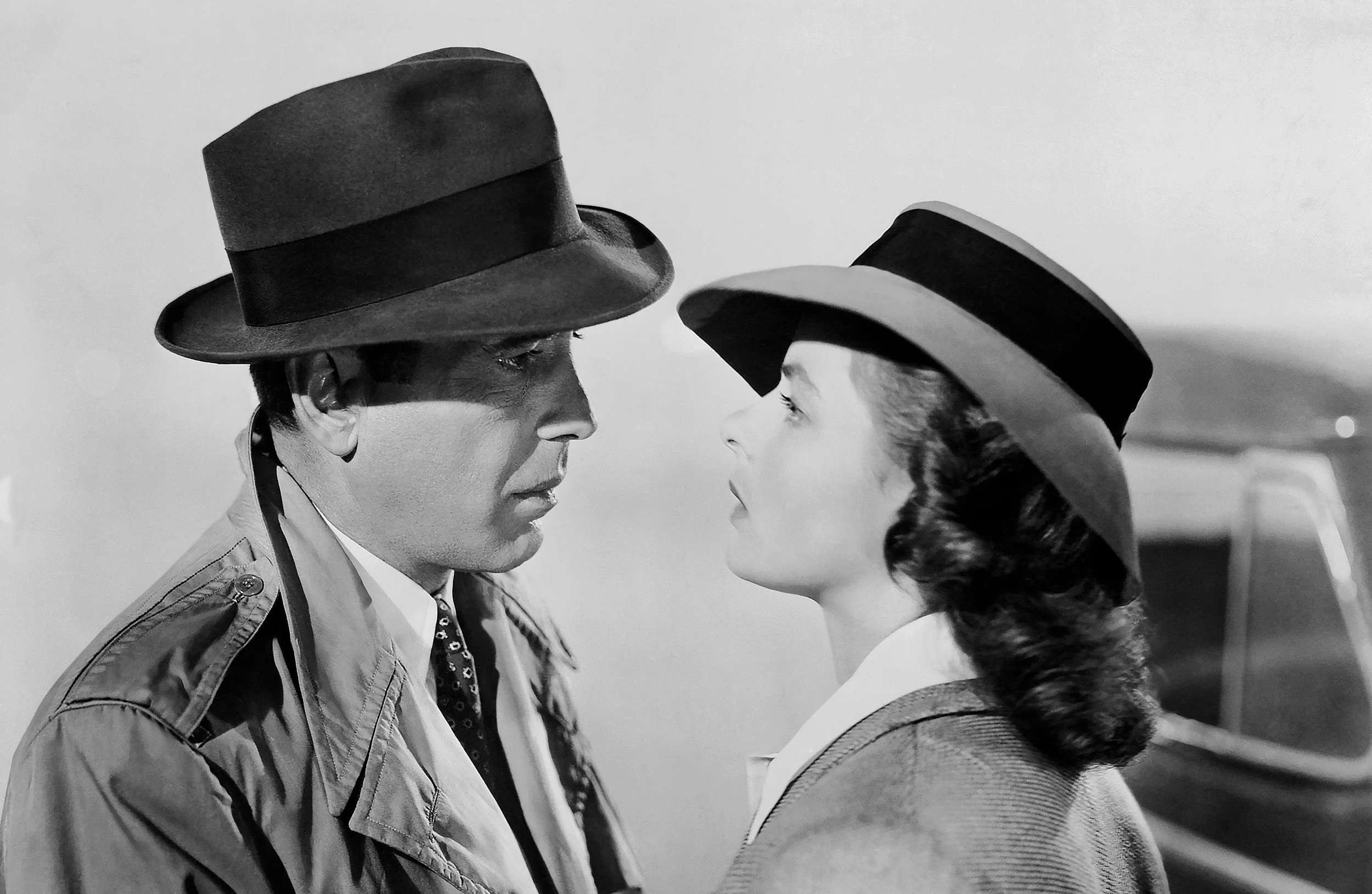
casablanca (1942)
There is no better example of Hollywood filmmaking than Michael Curtiz’ Casablanca. The patchwork assembly of a far-off place that exists only in the imagination, dreamed into life on the Warner backlot, filled with recognizable contract faces and a script that coins phrases with each passing second. The first act alone is relentless, staying put in one location, letting the wide array of characters come to us, and taking the stakes higher with each entrance. Somehow, Curtiz and the team pull off a seamless balance of romance, drama, comedy, action, intrigue and the beginnings of film noir in a WWII picture in realtime before anyone knew what it meant, it was just the current state of things. This, along with Lang’s early WWII films, more or less wrote the book on the mythos of the era, the spies of the underground, the iron fist of the third reich, the hopeless desperation of those caught between. Into this, Casablanca brings a lucid understanding of what was at stake, of the loss of humanity and the rise of a bleak machination dominating the world soul, the dreams of peace and self-determination and the rumble in the distance of approaching weapons of war, the marching boots of a fascist destruction trampling the lives that could have been. It’s to their credit that the film comes off as light and adventurous, detached with a certain whimsy to it all and the aloof coolness of Bogart taking another drag from the cigarette constantly burning in his hand as his eyes scan a world he no longer comprehends or wants much to do with. Yesterday being so long ago he can’t remember, and the future being too far away and uncertain to make any plans. He exists like all do in Casablanca, in a state of limbo, neither here nor there, and not even sure if here or there exist anymore in the turbulent new world.
It’s this purgatorial setting that adds Casablanca’s characteristic blend of inert urgency to each scene. Everyone is waiting, everyone is desperate, and everyone is growing increasingly willing to risk anything for the chance of escape. It’s a world caught in a trap it can’t break free from, and the exact characteristics that make us human are the key to release. Each of the characters with their humor in the face of danger, the disregard for authority no matter how threatening, taking risks against all odds, or for some, losing their convictions to compromise, embodies a different psychological response to peril. The full array of the human condition, with its dreams and its optimisms, its crushed hopes and its pessimisms, its failings and contradictions, the heart that yearns even when we pretended we’d moved on long ago, all are personified here. Love becomes the symbol of what was lost and what must be recovered, and what some believe never existed. Women, and the relationship that the men have toward them, become a symbol of virtue, idealism, liberty, dignity and compassion. The attitudes of the various men toward women represent how far into amorality they’ve fallen. Rick, constantly chastised by Louis as a ‘rank sentimentalist’, has lost his ideal, shut off his heart and plunged into his own underworld. A champion of lost causes, he’s now lost his will to find a cause at all, his isolationism reads as characteristically American in this gin joint United Nations that has arisen in the netherworld of Casablanca, sticking his neck out for nobody and not getting involved. Ilsa, and the bonds of love and commitment in general, become the salvation and hope for peace. Rick, losing Ilsa, is cast into the darkness, Victor is fighting to restore the balance and has the will to go forward due only to Ilsa’s presence. It’s not until his encounter with Annina and Jan, the young Bulgarian couple, that Rick is reminded of the nobility in life outside the hopeless nihilism of the war and the purgatorial city he inhabits. This is the turning point of the entire film as it is seeing those that life hasn’t torn apart yet that gives Rick new eyes, and restores his will to save others even if he can’t save himself. Characters like Louis or Ferrari show us those who compromise and fall in line with the spirit of the times. For Louis, the women of Casablanca are objects to be used and cast aside, the law is much the same, only as good as it is convenient, and can be changed and broken at any time. His performative act of ‘rounding up the usual suspects’ and legally condoning/covering up the murder or Ugarte as a suicide cement his slow slide into chaos, Ferrari displaying this objectification from the side of the market, with human beings as commodities.
And, all the while, the vaudevillian charm of studio Hollywood plays the whole thing as a mass masquerade of showmanship. The interjection of comedic bits as well as musical numbers via the cafe’s floor shows, even anchoring the entire romance of Rick and Ilsa around the film’s most memorable recurring number ‘As Time Goes By..’ is pure theater. It’s the deft balance of the artifice with the reality that casts a spell in each sequence, the horror of war existing alongside the humane, the tragedy and the comedy, the anthem of the destroyers drowned out by none other than La Marseillaise. Those who would create beauty protecting it from corrupting hands, watering the garden with champagne before letting the invaders drink it. The key source of the comedy is almost always in the revelation of the hypocrisy and inherent contradiction which is allowed to run rampant without being acknowledged once it starts to take hold. Louis using gambling as a pretext to close the cafe while being presented with his winning, the pickpocket warning us of the ‘vultures’ lurking while lifting the wallet at the same time. It is only with the entrance of those who won’t compromise, the selfless ones, that one by one the characters are drawn back toward virtue. Even Ilsa begins to slip, and Rick, returning the favor, won’t allow it. It’s how we keep each other in check, keep each other going, how community and camaraderie and as Rick puts it “beautiful friendship” are the key that unlocks the trap of a dying world. Everybody comes to Rick’s to weather the storm together, and together, repel the poison before it takes hold.
10